
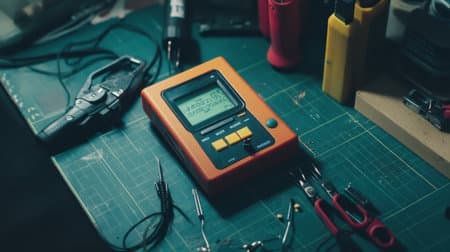
Why a good component tester matters
For makers, students and workshop technicians a component tester is more than a tool - it speeds debugging, confirms salvaged parts and shortens development cycles. Communica stocks practical handheld meters, LCR/ESR benches and integrated transistor/diode/IC analysers that put verification beside your bench or in your kitbag. Local availability reduces downtime and gives you access to branch pickup, VAT-compliant invoices and account quotes for education and procurement teams.
Quick overview: types of component testers
Choose a tester type based on the components you routinely handle and the level of precision required.
| Tester Type | Best for | Typical readout |
|---|---|---|
| Handheld multimeter-style | Quick polarity/resistance/diode checks | Voltage, resistance, diode drop |
| LCR/ESR bench | Capacitors, inductors, ESR at multiple frequencies | Inductance (L), Capacitance (C), Resistance (R), ESR |
| Transistor/IC/diode analyser | Semiconductor identification and pinout | Type ID, hFE, pin mapping |
Selection criteria - what to prioritise
- Range & resolution: ensure the tester covers the expected capacitance (pF to mF) and resistance ranges for your projects.
- Test frequency for LCR: 100Hz, 1kHz and 10kHz give different readings - choose a tester that matches datasheet test conditions when accuracy matters.
- ESR capability: essential for checking electrolytic capacitors in power supplies.
- Component identification: automatic type detection saves time in salvage and classroom labs.
- Build and safety: fused inputs, reinforced probes and clear isolation are valuable for repeated workshop use.
Practical SA considerations
Communica maintains stock across branches to reduce lead times and supports branch collection for most stocked items; view branch details at Branches & Trading Hours. For broader browsing, explore component and equipment categories at Collections or the full product index at All Products. Popular brands carried locally include bench favourites and maker brands - check the shop-by-brand list for compatibility and alternatives at Shop by Brand.
Specification callouts to check on the product page
- Measurement ranges and resolution (for L/C/R and ESR).
- Test frequencies available and whether the instrument reports reactance/X or phase.
- Accuracy specs and calibration options if you need lab-grade results.
- Input protection and recommended test leads/accessories.


